people in motion

people in motion
Affichage des articles dont le libellé est Economics. Afficher tous les articles

dimanche 29 décembre 2013

Bitcoin Fever

Bubble or not Bubble ?


2014 is set to be a banner year for BoomBustBlog. As you may have noticed, postings have slowed down to almost nothing. This due to another battle with hackers on the server. As we bounce back, we will take the global macro world by storm. This includes the digital currencies and how they will affect the world as we know it.


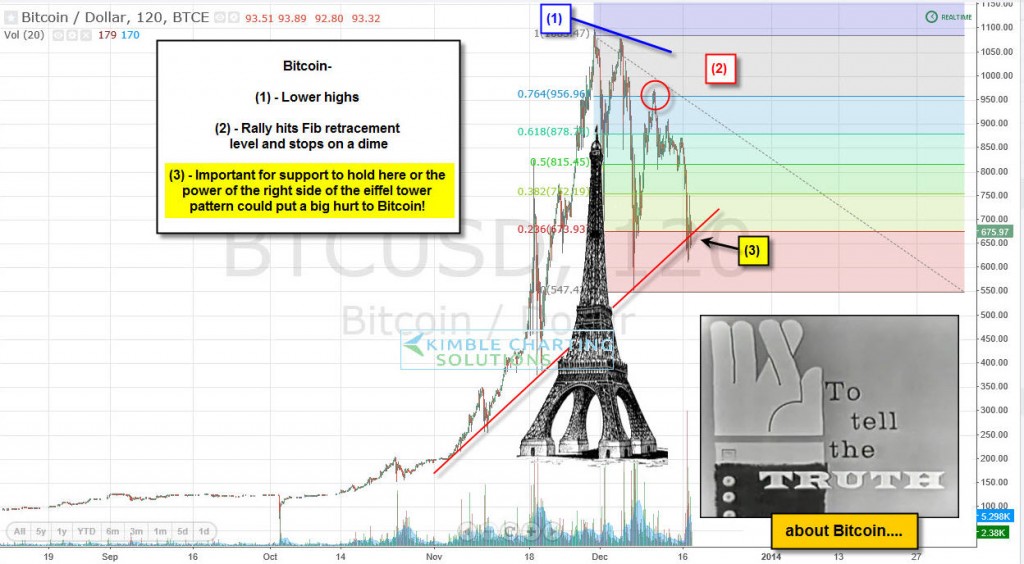
I'm not a gold bug, I'm not crypto-currency bug, I'm a risk-adjusted return bug! I attempt to see things as they truly are and will call it as I see it. Those of you who instanteously dismiss Bitoin as a bubble or Ponzi scheme are likely doing so without taking the time to fully understand it (it is quite different, I must admit), or read the disruptive change that it's capable of bringing into play - a disruptive change at the level of the Internet and World Wide Web during the the early to late 90's. 


The Definitive History Of Bitcoin

Here is the definitive history of the famous crypto-currency. From the pseudonymous "Satoshi Nakamoto"'s founding to the innovation of block chains to the "genesis block", buying pizzas, Sandiches, Teslas, and now houses... Bitcoin has come a long way (and where it goes is anyone's guess)...

see infographics here 


A Trip Through The Bitcoin Mines
Once upon a time, money - in the form of precious metals - used to be literally dug out of the earth. Limitations on the amount that could be mined, and on how much growth could be borrowed from the future (all debt is, is future consumption denied), is why eventually the world's central bankers moved from money backed by precious metals, to "money" backed by "faith and credit", in the process diluting both. It was the unprecedented explosion in credit money creation that resulted once money could be "printed" out of thin air that nearly destroyed the western financial system. Which brings us to Bitcoin, where currency "mining" takes place not in the earth's crust, or in the basement of the Federal Reserve, but inside supercomputers.
It is these supercomputers, that are the laborers of the virtual mines where Bitcoins are unearthed, that the NYT focuses on in a recent expose:
Bitcoins are invisible money, backed by no government, useful only as a speculative investment or online currency, but creating them commands a surprisingly hefty real-world infrastructure.

Instead of swinging pickaxes, these custom-built machines, which are running an open-source Bitcoin program, perform complex algorithms 24 hours a day. If they come up with the right answers before competitors around the world do, they win a block of 25 new Bitcoins from the virtual currency’s decentralized network. The network is programmed to release 21 million coins eventually. A little more than half are already out in the world, but because the system will release Bitcoins at a progressively slower rate, the work of mining could take more than 100 years.
As the following chart shows, in addition to the surge in the price of Bitcoin, another explosion witnessed recently is in the processing power of the Bitcoin network: from non-existent a couple of years ago, the "mining" power dedicated to hashing, or the calculations used to extract new Bitcoins,has risen to nearly 10 quadrillion per second!
So what do these supercomputer-populated mines look like? Below we look at two examples of just that.
* * *
First, we look at Hong Kong, where one of the largest Bitcoin mines in the world is located.
In an industrial backwater near Hong Kong's massive port, one of Asia's largest Bitcoin mines is quietly turning raw computing power into digital currency.
Located about eight miles from the city's finance hub, the entire facility is no larger than a two-bedroom apartment. Aside from a small bathroom, the mine offers no creature comforts.
It is dominated by vertical racks that house hundreds of ASIC chips. Shorthand for application-specific integrated circuits, these chips are custom-built to mine bitcoins.
These racks house hundreds of ASIC chips used to mine bitcoins.
Chinese investors have been enthusiastic early adopters, a trend amplified by a lack of more traditional investment vehicles in the country
The Kwai Chung mining facility is extremely quiet -- except for the whirr of computers
Industrial bitcoin mines devote their massive amounts of computing power to working on the algorithm, and are rewarded with an equivalent share of bitcoins. Currently, a winner is rewarded with 25 bitcoins roughly every 10 minutes.
A closer look at the towers. Most of the facility is devoted to mining for an investor group in China.
Miners are lured to Hong Kong because of its proximity to chipmakers in China and the city's permissive regulatory environment.
A bubbling liquid produced by 3M cools the ASIC chips.
This mine was purpose-built by Allied Control for clients based in China.
Kar-Wing Lau, Allied Control's vice president of operations, said the mine is cheaper to run and more efficient than many others because it uses a technology called immersion cooling.
Heat sinks and fans are typically used to disperse the heat generated by massed ranks of computer chips, but this Hong Kong mine is liquid-cooled using a product developed by 3M.
The processors used in the mine were build specifically for mining. They have no other function. "These ASIC chips, they can mine bitcoins and do nothing else," Lau said. "Given the pace of advancement, we need them to be constantly upgraded."
These radiators, housed on a balcony outside the mine, help disperse heat produced by the chips.
Immersion cooling allows Allied Control to leave less space between the chips, which saves money that would otherwise be spent on rent.
The technology also cuts down on electricity use -- one of the other major costs associated with Bitcoin mining. Lau wouldn't reveal how much it cost to build the mine, but he said that electricity bills for a fully-operational mine of this size would typically exceed $50,000 per month.
"The real question from a business perspective is how efficiently you can run your mining operation," Lau said.
The inside of the racks used to house the mining chips.
Cooling, however, is only one of the key factors when determining Bitcoin "mine" placement. Another key one: access to cheap electricity, because those massive servers sure soak up a lot of electricity: electricity, whose costs can quickly add up once a parallel processing cluster gets big enough.
* * *
Which brings us to Bitcoin mega-mine #2 in Iceland.
It is here that the NYT goes searching for digital excavators used to procure the digital currency.
On the flat lava plain of Reykjanesbaer, Iceland, near the Arctic Circle, you can find the mines of Bitcoin.

To get there, you pass through a fortified gate and enter a featureless yellow building. After checking in with a guard behind bulletproof glass, you face four more security checkpoints, including a so-called man trap that allows passage only after the door behind you has shut. This brings you to the center of the operation, a fluorescent-lit room with more than 100 whirring silver computers, each in a locked cabinet and each cooled by blasts of Arctic air shot up from vents in the floor.

“What we have here are money-printing machines,” said Emmanuel Abiodun, 31, founder of the company that built the Iceland installation, shouting above the din of the computers. “We cannot risk that anyone will get to them.”

Mr. Abiodun is one of a number of entrepreneurs who have rushed, gold-fever style, into large-scale Bitcoin mining operations in just the last few months. All of these people are making enormous bets that Bitcoin will not collapse, as it has threatened to do several times.
Iceland's low electric bill and its effective infrastructure, may be a reason why the one country that rebelled against the banker syndicate and jailed some of its bankers, may become the place where the bulk of Bitcoin mining takes place:
The computers that do the work eat up so much energy that electricity costs can be the deciding factor in profitability. There are Bitcoin mining installations in Hong Kong and Washington State, among other places, but Mr. Abiodun chose Iceland, where geothermal and hydroelectric energy are plentiful and cheap. And the arctic air is free and piped in to cool the machines, which often overheat when they are pushed to the outer limits of their computing capacity.

The operation can baffle even those entrusted with its care. Helgi Helgason, a burly, bald Icelandic man who oversees the data center that houses the machines, said that when he first heard that a Bitcoin mining operation was moving in he expected something very different. “I thought we’d bring in machines and put bags behind them and the coins would fall into them,” said Mr. Helgason, with a laugh.
No coins, but the cash miners get in exchange for BTC, especially if each Bitcoin continues to trade close to $1000, the mining can be quite lucrative. The flipside, however, is that the business is just as if not more capital intensive than running a gold mine for the same profit.
Until just a few months ago, most Bitcoin mining was done on the home computers of digital-money fanatics. But as the value of a single Bitcoin skyrocketed over the last few months, the competition for new coins set off a race that quickly turned mining into an industrial enterprise.

“Even if you had hardware earlier this year, that is becoming obsolete,” said Greg Schvey, a co-founder of Genesis Block, a virtual-currency research firm. “You are talking about order-of-magnitude jumps.”

The work the computers do is akin to guessing at a lottery number. The faster the computers run, the better chance of guessing that right number and winning valuable coins. So mining entrepreneurs are buying chips and computers designed specifically — and only — for this work. The machines in Iceland are worth about $20,000 each on the open market.
...

In February, Mr. Abiodun used the investors’ money to buy machines from a start-up dedicated solely to manufacturing specialized mining computers. The competition for those computers is so intense that he had to pay for them and wait for delivery.

When the delays became lengthy, however, he went on eBay and paid $130,000 for two high-powered machines, which he set up in June in a data center in Kansas City, Kan.

This was the beginning of Mr. Abiodun’s company, Cloud Hashing, which rents out computing power to people who want to mine without buying computers themselves. The term hashing refers to the repetitive code guessing that miners do. 

Today, all of the machines dedicated to mining Bitcoin have a computing power about 4,500 times the capacity of the United States government’s mightiest supercomputer, the IBM Sequoia, according to calculations done by Michael B. Taylor, a professor at the University of California, San Diego. The computing capacity of the Bitcoin network has grown by around 30,000 percent since the beginning of the year.
What is the upside of mining?
At the end of each day, the spoils are divided up and sent to Cloud Hashing’s customers. Last Wednesday, for example, the entire operation unlocked 225 Bitcoins, valued at around $160,000 at recent prices. Cloud Hashing keeps about 20 percent of the capacity for its own mining.
To be sure, like any industry in its infancy, there are numerous glitches, and mining for Bitcoins is no different:
Some Cloud Hashing customers have also complained on Internet forums that it can be hard to get a response from the company when something goes wrong. But this has not stopped new contracts from pouring in. Cloud Hashing now has 4,500 customers, up from 1,000 in September.

Mr. Abiodun acknowledges that the company has not been prepared to deal with its rapid growth. He said he had used $4 million raised from two angel investors to add customer service representatives to offices in Austin, Tex., and London. Cloud Hashing is now preparing to open a mining facility in a data center near Dallas, which will hold more than $3 million worth of new machines being produced by CoinTerra, a Texas start-up run by a former Samsung chip designer.

The higher energy costs — and required air-conditioning — in Texas are worth it for Mr. Abiodun. He wants his operation to be widely distributed in case of power shortages or regulatory issues in one location. But he is also expanding his Icelandic operation, shipping in about 66 machines that have been running for the last few months near their manufacturer in Ukraine.

Mr. Abiodun said that by February, he hopes to have about 15 percent of the entire computing power of the Bitcoin network, significantly more than any other operation.
Hopefully Bitcoin will still be around by then.


* * *
The future of Bitcoin mining is uncertain. There are a fixed number of bitcoins available -- and more than half have already been extracted. Kar-Wing Lau of the Hong Kong-based Allied Control, compared the explosion of professional mining operations to an arms race. For now, it appears to be a profitable endeavor. Lau said that Allied Control is currently exploring other mining platforms, including a mine built in a shipping container -- something that could prove useful if regulators crack down on the currency.


mercredi 30 octobre 2013

China debt crisis


Fears of a looming China debt crisis 

Equities around the world got dinged and the yen jumped Wednesday after Chinese money-market rates spiked and a Bloomberg story said China’s biggest banks had tripled debt write-offs. So, what is going on?


Given concerns earlier this year about the Chinese shadow banking sector it would appear that the acknowledgement that there is a problem and Chinese authorities are starting to deal with it has seen some investors take some money off the table in case there are a lot more provisions to come,

It’s no wonder officials and investors are keeping a close eye on the situation. A major hit to the Chinese banking sector is likely to have massive ramifications across the G-20 universe and could have a deflationary impact on global growth. Little wonder then that Aussie saw so much selling pressure in overnight trade as it will likely suffer the most from any drop off in Chinese demand.

After falling sharply in recent days, especially yesterday after the disappointing jobs data, the US dollar is broadly higher today, with the yen the main exception.  It has strengthened by almost 1% today.  

Many are attributing the price action to news that the five largest Chinese banks tripled the bad loans written off in the first half of the year to CNY22.1 bln (~$3.65 bln). Yet, tellingly and importantly, the Chinese banks had already made the provisions and thus did not, reportedly, impact the record profits (~$76 bln) in H1.  

There is some speculation that this is a precursor to a wave of defaults, but in itself writing off the bad loans is a very important step in its own right.  It is a step toward modernization and liberalization.  Provisioning for bad loans and then drawing on those provisions is part and parcel of a modern banking system.    

Precisely why one would sell, say the New Zealand dollar, the weakest major currency today, losing about 1.4% through the European morning, or the Mexican peso, which, with a 0.8% loss is the weakest among the emerging market currencies, in response to Chinese banks writing off bad loans in the first half of the year, is not immediately self-evident.   Indeed, not writing off bad loans, we would argue, was part of the problem.  Writing off bad loans is part of the solution.  For the record, the yuan itself rose to a new 20-year high against the dollar.  

There is another liquidity squeeze in China today.   Corporate tax payments are draining liquidity and thus far the PBOC has not deemed it necessary to counter this.  However, after money market rates jumped the most since July, the PBOC is likely to respond tomorrow.  The 7-day repo jumped 47 bp to 4.05% and the 1-day repo rose 72 bp to 3.80%.  

The PBOC's ability to manage the liquidity conditions seems clumsy and often responding belatedly to clear signals of important imbalances.  Admittedly, at times, the PBOC may be trying to send a signals of displeasure, like it did earlier this year, about wealth management products and shadow banking.  That does not seem to be the intent now.  

The firmer headline CPI, though still concentrated on food prices and not the general price level, and rising house prices has spooked some investors who feared a policy response.   The rise in money markets is not a prelude to a rate hike or a snugging of monetary policy.   That is in fact, the point, there is no policy implication, except to reinforce the perception of the PBOC's difficulty in managing liquidity.  

The rise in money market rates may be a key spur to the largest decline of small company share prices in a year and a half.  The ChiNext index of small companies fell 2.9% today, more than twice the decline of Shanghai Composite.  In comparison, Japan's JASDAQ fell 0.8%, while the Nikkei lost almost 2%.  

It strikes us that many observers seized upon the story to explain the price action throughout the capital markets.  We suspect that if the markets were advancing, many would cite Chinese developments too.  Instead, we suggest there have been some large moves in recent days, and the new positions were in weak hands.  That is to say, the dollar and yen's bounce and the pullback in shares is more a function of market positioning than Chinese banks finally writing down bad loans four months ago, for which provisions were already made. 


dimanche 20 octobre 2013

RUSSIA CALLING ! part 2


РОССИЯ ЗОВЕТ ! - RUSSIA CALLING ! 


Putin seeks to double labor productivity to end ‘oil needle’ reliance
Speech at the Russia Calling! Investment Forum:

At Russia Calling two years ago, Putin summed up Russian society in a sentence. He said the country has faced economic disasters many times and always came back.  Russia is always waiting for the worse to happen.  One of the reasons Putin is in power is because he’s basically made a promise never to take Russia over the edge again.

That the worst is happening next door in Europe, and farther away in the U.S., doesn’t help.  The investment sentiment of wealthy Russians is in decline. There’s a lot of wealth in Russia, but on balance, those with money are not putting it to work.
This year President Vladimir Putin to the usual standing-room-only crowd at Russia Calling said “Our problem is that we are not efficient, our economy is as big as Germany’s. Our per capita income is as high as some European countries. But the good news stops there.”
The Putin smirk. (call it his Mona Lisa smile). The Russian president said the economy was "inefficient" during VTB Capital's Russia Calling!
The Russian economy is operating well below its potential and a 3.1% labor productivity rate is intolerably low for the country poised to become Europe’s biggest, President Vladimir Putin told the 5th Russia Calling! investment forum in Moscow.
“The key bottleneck for the Russian economy is its low efficiency. In terms of GDP, Russia is poised to become Europe's number one economy and the fifth biggest in the world, adding that Russia is on a par with other countries in the EU in terms of per capita GDP and consumption.
However, labor productivity is now less than half the level of most developed economies – at 3.1 percent. In coming years, productivity must increase by 5%-6% a year, twice the current rate. "Only in this way can we overcome the efficiency gap," the president said. "I am confident that we are capable of doing that," he concluded. 
The current abyss between consumption and productivity is dangerous, Putin said. “Living off rent from natural resources, at the expense of future generations, unearned wealth cannot be stable or long term," he added. 
Oil and gas revenues now provide for more than a half of Russia’s budget, with various institutions repeatedly warning that such a oily black hole could soon swallow the country’s economy.
Comfort in store for investors in Russia
Hopes for a rapid recovery of the world economy were not justified; the recovery of the global financial system will be prolonged. And only concerted actions of states and new sources of development can speed it up. This came as a statement by Vladimir Putin during his speech at the "Russia Calling!" investment forum, which was held in Moscow on October 1-3.
The world economy has already lived through its worst days, but it is clear that a quick recovery is not to be expected. The structural crisis of the global financial system had its effect, Vladimir Putin noted.
"The acute phase of the crisis is overcome; the current risks are more or less taken under control. However, hopes for a quick recovery of the global economy, if there were any, are not justified. The crisis of the existing economic model is structural, which means it has a long-term character."
Concerted steps and new sources of development are needed. According to the President, this very approach was laid in the basis of the Russian G20 chairmanship, and then enshrined in the final St. Petersburg plan of action. Vladimir Putin stressed that the G20 countries had found mutually acceptable solutions of many issues.
"A specific program of the G20 work aimed at improving the investment climate and encouraging long-term financial investments was developed and is already being implemented. The key issue at the summit was the problem of a tax policies reform aimed at dealing with tax evasions, including the use of off-shore zones. We have adopted a fundamental decision on this issue. A joint plan of actions for combating the dissolution of the tax base was approved. We have also agreed on standards of information sharing for tax purposes."
Vladimir Putin has also touched upon foreign trade matters at the “Russia calling!” forum. Its volumes are decreasing, but working together, the G20 will be able to resist it.
“The Group of Twenty has reaffirmed its support of the trading system. We have agreed to extend the commitments of our countries to limit protectionism in the global trade until the end of 2016. I must tell you, it was a difficult task to persuade all the participants of this meeting to agree to this decision.”
However, some countries continue to use protectionist measures and put a spoke in the wheels of Russian producers. Russia could not but react to violations of the regulations of the international trade, the Russian leader said.
“As examples of protectionist measures I’d like to cite “energy adjustments” used by the European Commission while conducting anti-dumping investigations into Russian exports, as well as the notorious “Third Energy Package”, quotas on supplies of agricultural products and tariff policy in respect of rail transportations through the territory of some EU countries. We will learn to defend the rights of the national business, and actively use the WTO mechanisms as the old-timers of this organization do”.
Vladimir Putin gave a commission that the government together with the business community should start the procedure of protecting the interests of Russian producers on foreign markets in the framework of the WTO.
The President has specially dwelled on the topic of attracting investors to Russia. The volume of direct foreign investments in the Russian economy is growing: during the first half-year it reached $ 55 billion. This is three times more, than during the similar period of 2012.
In order for these investments to increase further, Russia intends to develop private-public partnership.
“The state will share the risks of private investors, putting up money on a repayable and reimbursable basis. I’d like to emphasize that both the first and the second are money from the National Wealth Fund. Mechanisms of concessions, co-financing, and other forms of private-public partnership will be widely developed. These changes in the legislation are being worked out currently.”
Private-public partnership will be applied during the implementation of major infrastructure projects: modernization of the Trans-Siberian Railway and BAM, construction of the Central Ring Road and high-speed Moscow - Kazan railway. It is in these projects that the money from the National Welfare Fund will be invested. Vladimir Putin has cited Abu Dhabi, which intends to invest up to $ 5 billion in the construction of Russia's infrastructure, as “the first robin” of private-public partnership with foreigners. One of Russia's advantages in attracting foreign investments is reduction of inflation, which, according to the President, has all the chances to be below five percent next year.

RUSSIA CALLING ! part 1


РОССИЯ ЗОВЕТ ! - RUSSIA CALLING ! 

VTB Capital Investment Forum 2013

The “Russia Calling!” Investment Forum provides a platform for developing dialogue between Russian business and the international investment community. Prominent political and business community figures from around the world are taking part in the event. The forum is examining development trends in the Russian and global economies and the state’s role in an investment model for growth. 
This year  winter came early over the Russian Capital with light snow showers in this begining October. Sitting here in the 12th floor in a tower in Moscow looking down on a cold, wet and white city.. It's definitely sad. 
The first flakes are unmistakable. They don't fall like the fluffy white powder of December, so much as slap you in the face with the full force of October's wet promise of the six months of gloom that lie ahead. So it was at 11.30am on Tuesday. The immediate response is confusion – why is my coat turning white? Then comes denial – is it just oddly coloured rain? And finally, acceptance – here we go again.
Winter is, of course, Moscow's natural state. The slightest hint of frost brings Russians fumbling for their furs, checking skating rink schedules, ensuring soup ingredients are in full stock. And yet there are constant attempts to challenge its inevitable path.
And it is the same for the general state of the economy and the Russian situation the later months. We can only hope that Christmas is getting closer.


Opening the forum, Economic Development Minister Alexey Ulyukaev said that being there reminded him of an old joke that says: We don't have culture, but we do have a Culture Minister, and he feels really well! 
"Practically, there is no economic development [in Russia]," Ulyukaev said, paraphrasing the joke, "but the Economic Development Minister is here, in front of you!" But unlike the minister in the joke, he is feeling poorly, Ulyukaev added. 

Ulyukaev is one of those Russians that match perfectly the American idea of the Russian archetype. The man’s a bear with short, gray-spiked hair. In the three years I’ve been coming to Russia Calling!, I’ve never once seen him smile.

The morning sessions were full, and every door was guarded by a stone faced bouncer. 
It seemed the size of his arms reflected the degree of importance of the attendees.

A take it away economy 


Perhaps he has a reason. Foreign direct investment into Russia, the measure of foreign capital coming from corporates and portfolio flow, has gone from $74.7 billion in 2008 to $51.4 billion in 2012. That’s down from $55 billion in 2011, according to the International Monetary Fund.

“There is a very low participation of private Russian capital in our economy,” said Alexei Moiseev, the Deputy Finance Minister. “It resembles an old Soviet left over. I know a lot of people in the government would disagree with me. The truth is, we are aware of this problem and are doing something about it.”
Creating investing rules that are in accordance with that of the Organization of Economic Cooperation and Development is a starting point.

Let’s not forget, Russian capitalism is only 21 years old. If you start with the dissolution of the Soviet Union in January 1992 (officially was Dec. 26, 1991) as the start of Western-style economic practices being incorporated in the Russian economy, then you’ve got a capitalist system that turns 22 the day after Christmas 2013.

To use a drinking metaphor, by U.S. standards Russia is one year in to being legally able to handle its liquor. Bottom’s up.

Top Down


The macro view of Russia is a mixed bag. The investment view is a bag full of holes .

“We’re now trapped in an intermediate level of development,” said Moiseev. “This is not a cyclical slowdown in Russia. This is a structural one and it concerns us all.”

Last year, the Russian government spent around $1 billion on the world’s longest suspension bridge in Vladivostok, the peninsula that juts into the Sea of Japan. The Russky Island Bridge was built to help Russia tend to a number of big events happening in the east, like the Asia-Pacific Community Summit.
Russia has the Sochi Olympics to tend to this coming winter.

The Sochi airport terminal, which is expected to cater to 3,800 passengers an hour during the Olympics, is undergoing renovations to the tune of around $200 million. Basel Aero is doing the work, a company owned by metals tycoon.

Russia launched a new investment strategy for civil aviation this year. The investment volume is estimated at $9 billion, with over 100 sites currently undergoing reconstruction and modernization with help from both the private and public sector.

Ulyukaev is hopeful. “We expect and forecast a serious increase in investment and hope it reaches 4% in 2014, 5.5% in 2015 and over 6% in 2016,” he said. Wait…did he just smile?

If Russia can sell itself better — never an easy task for an amateur at 22 years of age — then more institutional money will flow. New policies will liberate big investors like pension funds to invest long term. It’s not going to happen over night, but neither did China’s move from $2 a day laborers pouring cement in Shanghai, to $50,000 a year Shanghai one-percenters shopping at Huang Shu Chi in Xintiandi.

The United Arab Emirates is taking note. The Abu Dhabi Department of Finance, the capital city’s long term investment vehicle, said last month it will invest $5 billion in Russian infrastructure projects over the next seven years.

Why Russia Is 'China In Reverse'

One of the Conference theme was that the actual situation of the Russian economy is the reverse of what the Chine has been implementing.

In the fun-house mirror of the global economy, Russia is the mirror opposite of China.
China consumers are the driving force behind the market. Russian consumers are hobbling along and maybe stuck in a middle income trap. China needs less investment. Russia needs more.
China used to be all about infrastructure investment: new roads, new bridges and airports. Now it's Russia's turn.
The kind of investment Russia needs doesn’t lend itself to a lot of sex appeal. We’re not talking about oil and gas giant Rosneft investing billions in Arctic drilling.  This is about roads and very big bridges.
“Russia is a reverse-China,” Alexei Yakovitsky, global CEO of VTB Capital said. ”China is a consumer theme for investors today,” he said, noting that not too long ago, investment was China’s theme. Now, investment is Russia’s theme. Years ago, it was the consumer. “Russian consumers still have room for growth, but that is no longer the story here. The story in Russia today is investment,” he said last Tuesday on the sidelines of VTB’s Russia Calling!, an annual investor’s forum in Moscow.
Consumers were the main growth driver in Russia for more than a decade. That was mostly because Russian consumption was bouncing off such a low base from the 1998 financial crisis, known as the “Russian flu”.  An overvalued currency, a war in Chechnya, and a bloated government led Boris Yeltsin to default on a $5.5 billion loan.  Russia was nothing but one big junk bond. Yields on its debt was stratospheric. Cosmonaut Yuri Gagarin could have seen them from space at 47%.
Consumers were the story again when Russia used its oil wealth to pump around $60 billion into banks and the stock market. Financial transfers in the form of higher wages and big pension fund gains thanks to government stimulus kept Russia’s economy whistling while everybody worked.
The whistling has stopped. There’s barely a  hum. The economy has grown just 1.5% so far this year, where a normal growth rate is closer to 3%.  The consumer story is stable, but waning.  While China shops and spends less on infrastructure, Russia retail sales are benign to flat. For the last three years, retail sales growth month over month averages about 0.6%, according to the country’s Federal Statistics Service. It reached a record low of -26.3% in January of this year.  China retail sales averaged about 1.18% month over month from 2010 to 2013, according to China’s National Bureau of Statistics. Its worst month in that period was a gain of 0.19%, recorded in January 2012.
If VTB’s China comparison is correct, then investors should expect Russia to remain slow and steady. They’ve already come to expect the government to be extra cautious.
Despite a weak investment climate, the ruble remains strong. Their current account has a surplus. The federal budget deficit is almost zero, and will be minimum for the next three years, promised Finance Minister Anton Siluanov.  The country’s debt to GDP ratio is under 11%, around seven times less that of the United States. “We’ve based our budget on just 1% GDP growth. We’re not exaggerating our opportunities here,” said Siluanov.
Private capital outflows re-accelerated in the third quarter to $12.9 billion from $7.9 billion in the same period last  year. That lifted the 12 month rolling total to $56.5 billion from $51.5 billion in the second quarter.
The reverse China theme better settle in quick if Russia is to ever shake off its last place status among the big four emerging markets.
Russia's Growing Pains Not All Europe's Fault
Russia Minister of Economic Development Alexei Ulyukaev: government could do better.
In 2013, Russia is getting worse. For some, it’s all Europe’s fault. Others prefer to lay the blame on the Kremlin, including top government officials.
A normal growth rate in Russia would be around 3%, but now it’s growing by half that, at 1.5% this year so far and expected to end the year under 2%.
“We do not expect any serious improvement in the overall market situation in Russia,” said Economic Development Minister Alexey Ulyukaev during VTB Capital’s annual Russia Calling! investment conference in Moscow on Tuesday.
Investment is shrinking this year. Industrial production has been a disaster, negative in January, February, May, June and July. August IP grew 0.1% on an annual basis. The only thing growing is consumer spending and that’s mainly because of rising government wages, which is actually a problem for the government budget because a large portion of Russia’s economy are state employees. The growth of fiscal volume of goods and services is primarily coming from inflation. Inflation here is around 6.5% currently.
Labor costs are up for three years in a row. Russia has had an increasing share of labor in GDP while the share of savings and investments are in decline. That combination of demand constraints and increasing costs — be it worker salaries or higher electricity bills — has created a situation where the performance of Russian companies are in decline.
Take natural gas behemoth Rosnef.They’ve been spending on acquisitions and signing joint ventures deals from Vietnam to Venezuela, but their net income is falling. In 2011, their net income was $12.4 billion. In 2012, it was $10.9 billion. Forecasts for this year are better, at $11.4 billion, but falling to $11 billion next year and $9.7 billion in 2015.
Falling net income constrains the capacity for Russian companies to fund investment projects which is one of the factors hurting demand for investments in Russia in the first place. Bad sentiment on Europe doesn’t help.
A week before, Prime Minister Dmintry Medvedev blamed much of Russia’s lackluster growth on the E.U., their chief trading partner.
“The European economy is teetering on the edge of recession, and has slowed growth in all BRICS countries. The U.S. economy cannot fully recover with high unemployment, and many individual Americans are just beginning to crawl out of debt,” Medvedev wrote in the official address on the state of the economy available on the Kremlin’s website if you can read Russian.
During the G-20 meeting in St. Petersburg this month, Vladimir Putin even said the “R” word: recession is back on the table.
Maybe not in Russia, but if Europe does worse than expected next year, it will surely hurt Russia’s plans.
Not that they have gangbuster plans here either.  This is a very conservative economic administration. Public debt to GDP is around 11%, lower than any of the big four emerging markets and light years lower than that of the budget-busting United States, which recently closed down Washington because they don’t now how to count. While ridiculous expectations are an American forte, lowered expectations are Russia’s thing.
The reduction in the investment scene is problematic, but not leading to Russia’s demise, said Anton Siluanov, Russia’s Finance Minister and one of the brains behind Russia’s recent budget cuts.
“Despite a weak investment flow, our currency is strong, the budget is strong, the budget deficit is almost zero, and will be minimum for three years to come,” he told investors at Russia Calling! this morning on a chilly October morning.  ”Plus, we’ve based this budget on just 1% GDP growth. We’re not exaggerating our opportunities.”
Investors may be growing tired of the usual Russian juggernauts. The Rosnefts and Gazproms are government entities, distributing profits throughout the budget and not using it to invest in growth as much as investors would like.  Things are changing, but at a tortoise pace and investors can be impatient. 
Privately held search engine, Yandex, has seen its net income double in two years from around $125 million in December 2010 to $265 million in December 2012. It gets better: first quarter net income was $295.2 million rising to $325 million in the second quarter.  The stock is up 31.72% in the last three months.
See part 2 President Putin Address